
Urbanism, After All
Office of Adrian Phiffer is not interested in “the systematic.”
Office of Adrian Phiffer is interested in the distinctions that are made through exploring “the bounds of architecture.”
This is how Adrian Phiffer started his talk in room 315F of The Cooper Union’s Foundation Building. The talk took the audience through fourteen projects from his office. Much of the work explor es themes of urbanism—not startling given that he is the 2026 Robert Gwathmey Chair in Urbanism. Projects presented include: a circus in Riga, Latvia; a museum in Sejong, South Korea (larger than the Louvre); and a house in Toronto with no windows described as “surprisingly respectful.”
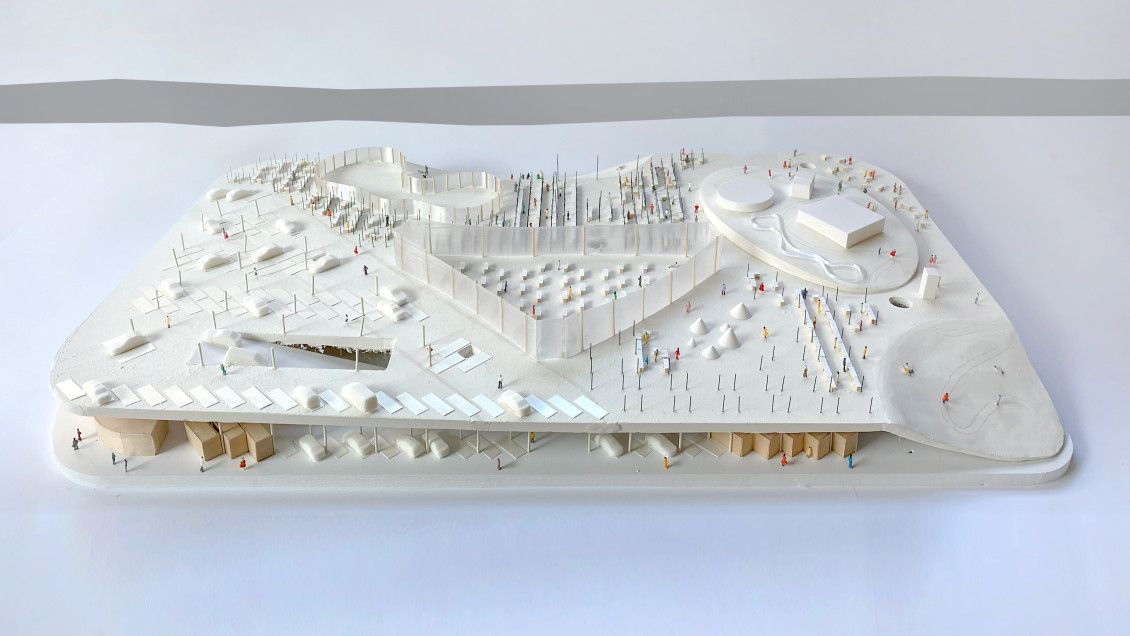
Phiffer presented a project for an art platform in Suncheon, South Korea—designed and modeled using sculpting clay—called The Garden of Earthly Delights. Across the site are dispersed “survivors,” a nod to John Hejduk’s “victims.” The survivors create what Phiffer describes as “a work of many parts, each with its own life.” Another significant project was a public art proposal, an illuminated thatched house on a stick called Ceci n’est pas une maison which serves two functions: countering Norman Foster’s high-tech architecture looming in the background, as well as confusing passersby that a person might be living inside.
After the presentation, the floor was opened to the audience for questions. Acting Dean Ben Aranda read his favorite excerpts from Phiffer’s book, met with protest from the author. Aranda followed by asking the first question, of course coming after his favorite line: “The first question will go to the students.”